
Cotswold Countryside Roofing · Gloucester
Chimney Repairs in Gloucester
The chimney is the most exposed part of any house and usually the last part anyone checks. Cotswold Countryside Roofing repairs, repoints and rebuilds chimney stacks across Gloucester, and deals with the leadwork and flashings that keep the join between chimney and roof dry. Whether you have damp showing on a chimney breast, mortar dropping onto the tiles or a stack that looks out of true, we will inspect it and give you a free estimate.
Get a free quote
Friendly, no-obligation quotes.
- Trusted Locally
- Fully Insured
- Experienced Roofers
- Quality Workmanship
- Free Estimates
- Customer Rated
Why so many Gloucester chimneys need work
A large share of Gloucester's homes were built when every main room had a fireplace. The brick stacks on the terraces of Kingsholm, Tredworth and Barton have stood in the weather for well over a hundred years, and the semis that followed between the wars have chimneys that are not far behind. Rain, frost and wind attack them from every side with nothing to shelter them.
Most of those flues went out of regular use once gas central heating arrived. A chimney nobody lights is a chimney nobody thinks about, so faults build up unnoticed until a pot comes down in a gale or a brown stain appears indoors.
Damp on the chimney breast: finding the real cause
A stain on the chimney breast or the ceiling beside it has several possible sources, and they need different cures. Flashing may have lifted or cracked where the stack meets the roof. Flaunching may have broken up, letting rain into the brickwork from the top. Open joints and porous bricks can soak up water in prolonged wet weather. An uncapped flue lets rain fall straight down the inside.
There is also a cause that is not a leak at all. A disused flue that has been sealed at both ends without ventilation traps moisture, which then shows through the plaster. We check each of these in turn so the repair deals with the actual fault.
Leadwork and flashings around the stack
The junction between a chimney and the roof covering is the commonest place for water to get in. It should be sealed with lead: an apron at the front, stepped flashing up each side and a back gutter behind the stack where water collects. On many older houses these details were formed in sand and cement instead, which cracks as the roof moves with the seasons.
We replace failed fillets and worn lead with new leadwork, properly dressed over the tiles or slates and fixed into the brick joints. Done correctly, it is one of the longest-lasting repairs on a roof.
Leaning, cracked or unsafe stacks
A chimney that leans, bulges or shows stepped cracks through the brickwork should be looked at without delay. Decades of flue gases can break down old mortar, and the side facing the prevailing weather often deteriorates fastest, which is one reason stacks begin to tilt. Loose bricks and pots are heavy and fall a long way.
If you are worried about a stack, call us on 01452 458131. We will assess it, make it safe if there is an immediate risk, and then advise whether it can be repointed, needs rebuilding or would be better taken down.
Disused chimneys: cap, reduce or remove?
If a chimney will never be used again, you have three sensible choices. The simplest is a ventilated cap on each pot, which keeps rain out while letting air move through the flue. The second is to reduce the height of the stack, leaving less masonry exposed to the weather. The third is to take it down below the roofline and slate or tile over the opening.
Shared stacks need your neighbour's agreement before they are altered, and listed buildings or homes in a conservation area may need consent. We will explain what each option involves for your particular chimney.
Looking after a chimney between repairs
You do not need to climb anything to keep an eye on a chimney. From the garden or the pavement, look a couple of times a year for pots sitting at an angle, greenery sprouting from the brickwork, or flashing that has curled away from the stack. Indoors, check the loft around the chimney after heavy rain for dark marks on the timber or the brickwork.
Catching these early usually keeps the job small. Repointing a stack while the bricks are still sound costs far less than rebuilding one after years of water and frost have worked into open joints. If you spot something and are unsure, send us a photo and we will tell you whether it needs a visit.
Access, safety and what to expect
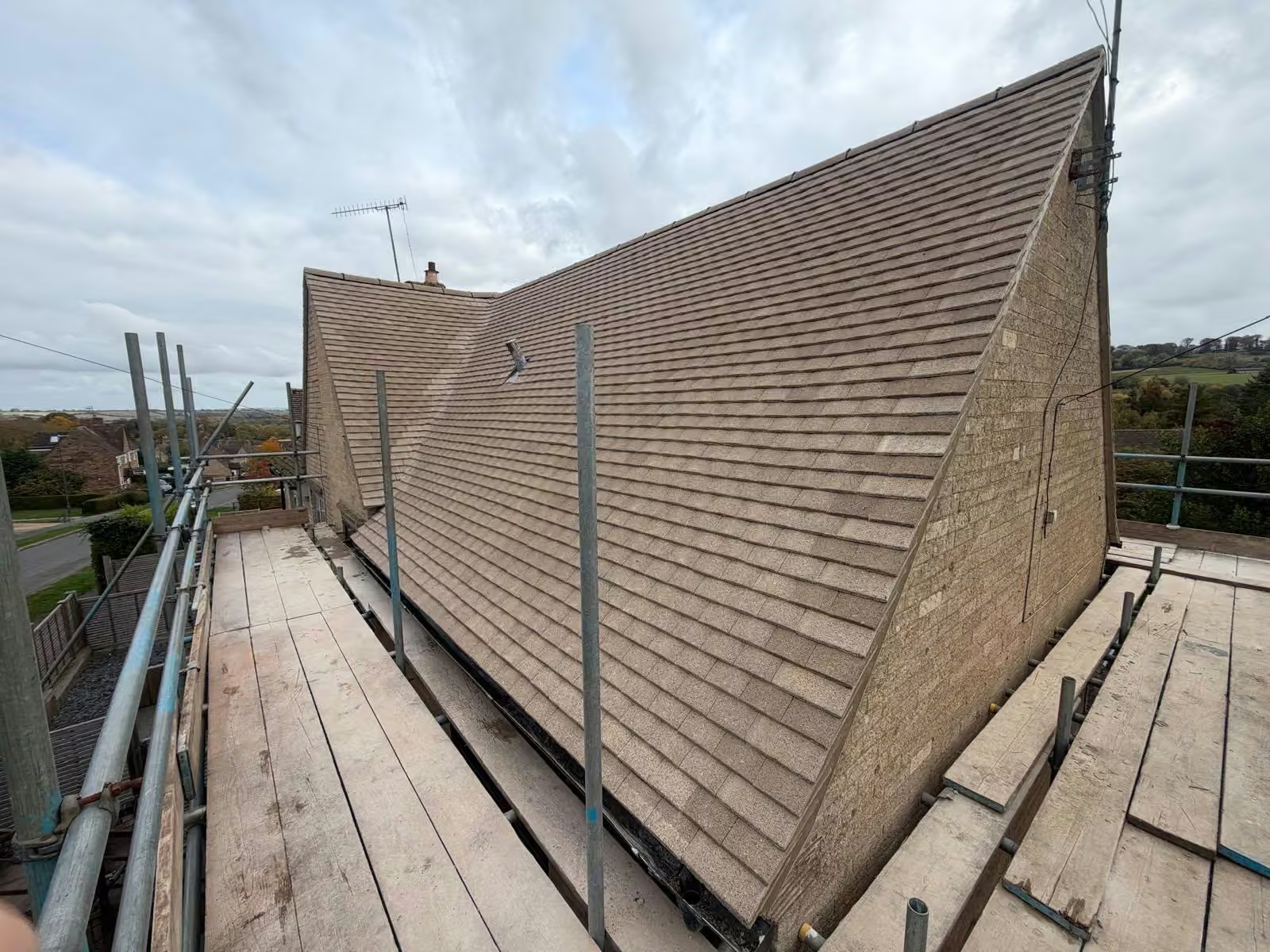
Chimney work happens at the highest point of the building, so safe access comes first. Most repairs need a chimney scaffold, and we include this in the estimate so the figure you see is the full cost. Before that stage, a drone lets us photograph the stack, pots and flashings at close range, which means you get an informed estimate without paying for access just to have a look.
The estimate is free and in writing. Once the work is complete, we remove all rubble and old materials and check that the surrounding roof has been left sound.
Check your location
Areas we cover around Gloucester
Our chimney repair work covers the whole of Gloucester together with nearby villages, where older cottages and farmhouses often have large stacks that have gone many years without maintenance. Get in touch with your postcode and we will confirm we can reach you.
- Gloucester
- Quedgeley
- Churchdown
- Longford
- Highnam
- Twigworth
- Maisemore
- Ashleworth
- Whitminster
Common questions
Frequently asked questions
It varies with the size and height of the stack, how much brickwork and leadwork is affected and the access required. We inspect first and then give you a free written estimate with everything included.
Most do, because the work is at the top of the roof and involves heavy materials. The cost of access is set out clearly in your estimate. Very minor jobs can sometimes be reached another way, and we will say so if that applies.
Yes. We can use a drone to take close-up photographs of the pots, flaunching, brickwork and flashings. You see the images yourself, so you understand the condition of the stack before agreeing to any work.
A stack that serves two houses is normally a shared responsibility, so it is best to speak to your neighbour first. We are happy to provide one estimate for the whole stack that you can both look at.
Look for mortar that has receded behind the face of the bricks, gaps you could push a key into, plants growing from the joints or sandy debris collecting in the gutter below. Any of these suggests the joints are due for attention.
It should be checked soon. Debris in the hearth or on the roof means material is coming loose somewhere on the stack or inside the flue, and it tends to speed up once it starts.
Yes, but with a ventilated cap. Rain entering an open pot causes damp, while sealing a flue completely traps moisture inside it. A ventilated cap keeps water and birds out and still allows airflow.
We can take a stack down to below roof level and make good the roof covering over it. If the chimney breast inside the house is also being removed, that needs separate structural advice. Shared and listed chimneys need the relevant permissions first.
We choose bricks and a mortar colour to sit as closely as possible with the original. New work always looks a little fresher at first and tones down as it weathers.
Yes. We regularly work on traditional buildings and use materials suited to their age. If the property is listed, consent may be needed before the stack is altered, and we can advise on what to ask the council.
Sudden damage caused by a storm is often covered, while deterioration through age is usually excluded. We can supply an estimate and photographs for your insurer, who will make the decision.
Other services in Gloucester
All areas we coverNeed a Roofer in Gloucester?
Give us a call or send a few details over. We'll come and take a look, tell you honestly what your roof needs, and put a free written estimate in front of you.
140 Brooklyn Rd, Cheltenham, GL51 8DY · info@cotswoldroofs.co.uk